

Key facts at a glance
- New Monte Rosa hut, which generates around 90 % of its energy itself.
- Cooling of the solar panel by natural convection investigated.
- Two variants compared: reference and a larger gap between panel and roof.
The "Neue Monte Rosa Hütte (NMRH)" in Switzerland
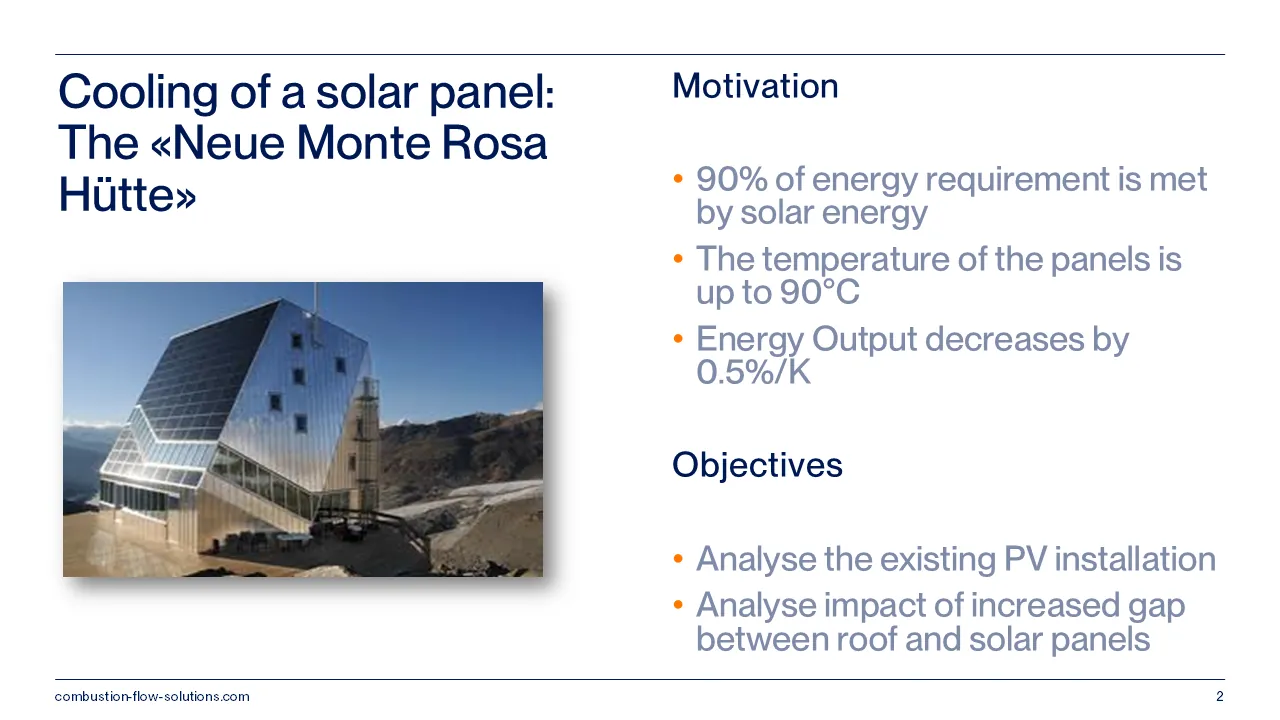
The hut is equipped with the latest high-tech and can produce up to 90% of the energy itself. One important part in the whole energy system is the solar panel, which of course must be very efficient.
Therefore the cooling of the solar panels was investigated through 3D CFD simulations. The following pictures gives an overview over the motivation and objectives.
Investigated designs
Two different desing variations have been investigated. The reference design and a design with an increased distance between the roof and the solar panel. The idea behind this increased gap is to allow more amount of air flowing through gap. The air flow occurs due to natural convection.
The following picture shows the two configurations, the geometry on one hand and the boundary conditions on the other hand.

Results
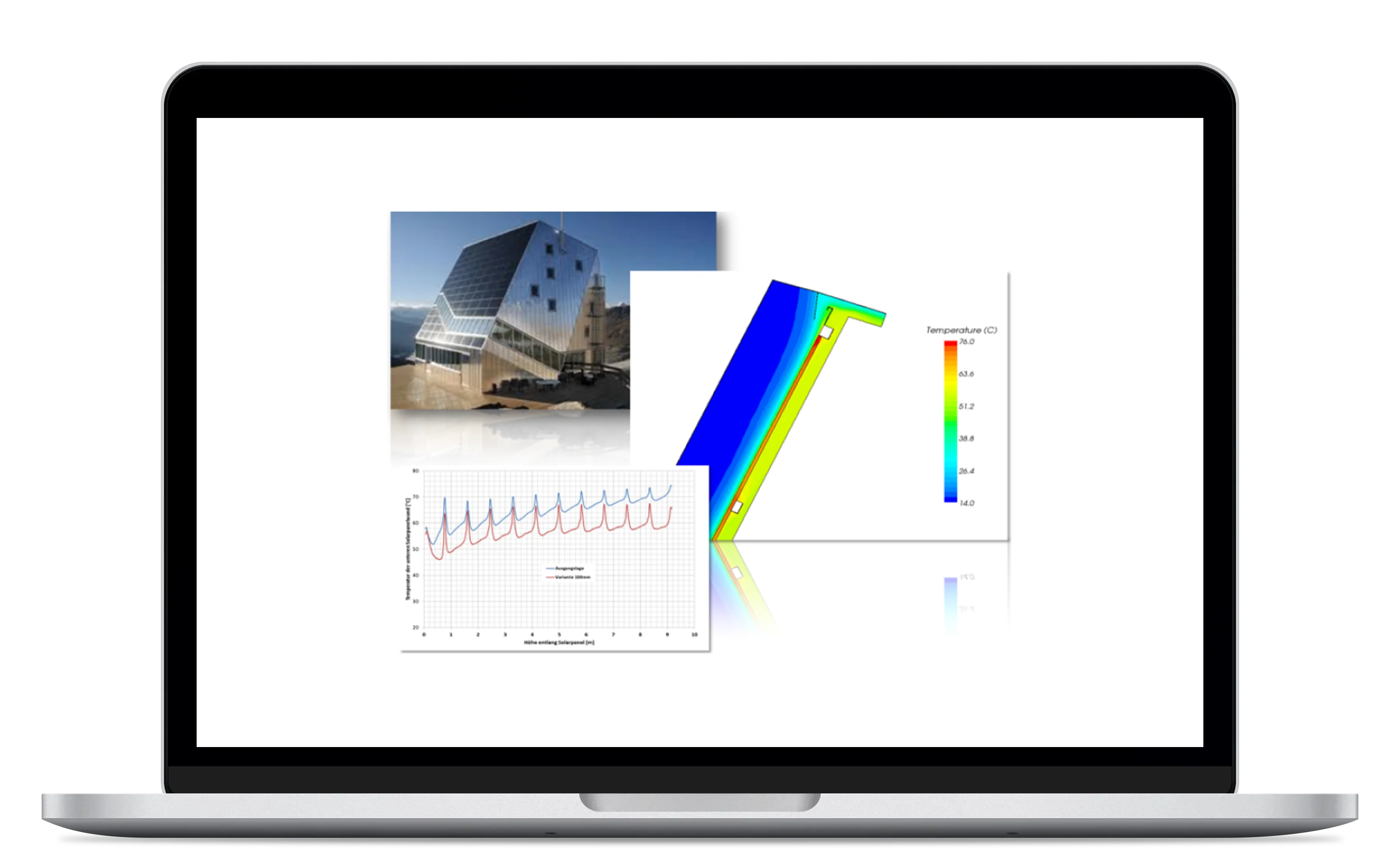
The following picture shows the temperature distribution of the solar panels and the surrounding air. It can be seen that an increased gap between the panel and the roof of the hut reduces the overall panel temperature due to better cooling effect.

The surface temperature of the panel along the height is shown in the following pictures which underlines the cooling effect of the "large gap" version.

Why is the cooling of solar modules important?
The efficiency of solar cells drops as their temperature rises. For a roof-integrated panel, cooling depends on how much air flows through the gap behind the panel. This flow is driven by natural convection, that is, solely by the buoyancy of the heated air. It is therefore weak and sensitive to the geometry.
How do you proceed?
- Modelling panel, roof and air gap with inlet and outlet openings.
- Specifying solar irradiation, ambient temperature and heat release.
- Calculating buoyancy-driven flow and heat transfer.
- Comparing variants, for example different gap widths.
Frequently asked questions
Can this be transferred to façades?
Yes. Rear-ventilated façades and building-integrated photovoltaics follow the same physical principles.
Which results does the simulation provide?
Temperature fields on the panel, the air velocity in the gap and the comparison between the variants.
Further reading: Safety and efficiency in building design · Our services
Share Project:
High performance cooling of a charging cable for HPC/MWC application
View Project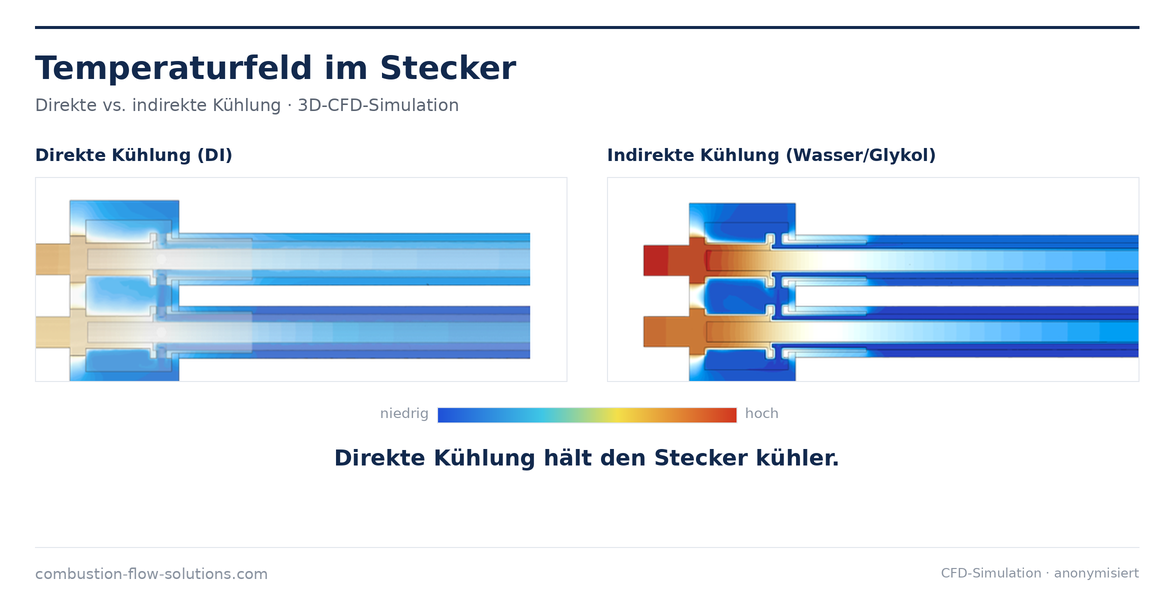
CFD-Simulation für HPC/MWC-Ladekabel: Steckertemperatur um bis zu 35 °C senken
Optimierte Flüssigkeitskühlung senkt die Steckertemperatur um bis zu 35 °C und verlängert die Lebensdauer.
Projekt ansehen